A Little History
Stanwood’s West End has been shaped by water, roads, businesses and generations of people building on the same ground. This section considers some of that history.
Before Roads – Waterways and Canoe Travel
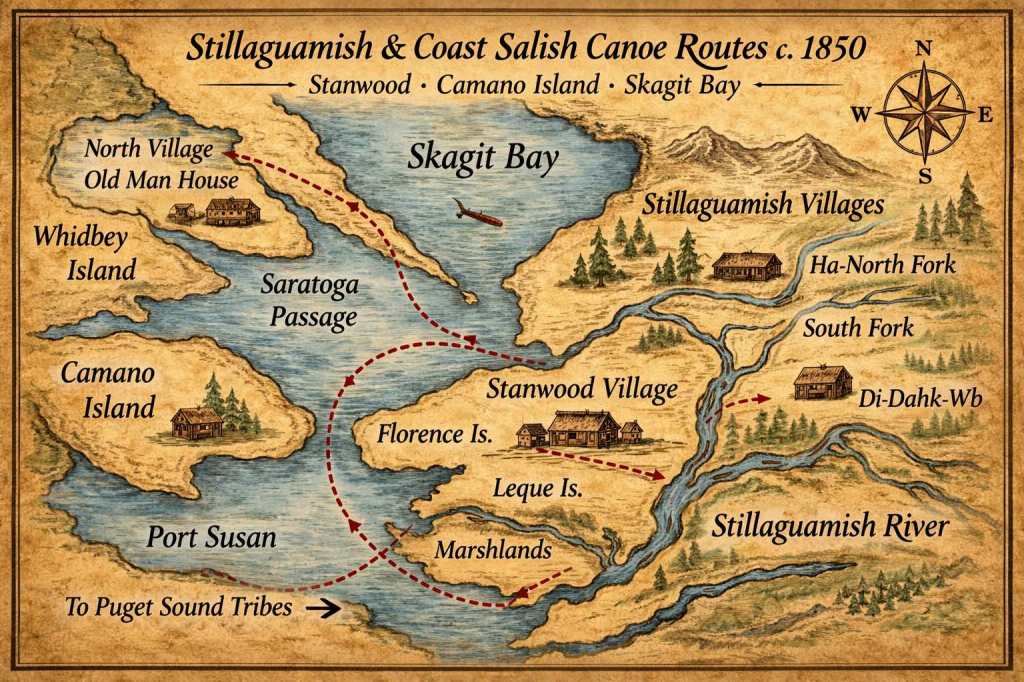
Interpretive illustration based on historic geography of the Stillaguamish delta and surrounding waterways.
Long before dikes and roads reshaped the Stillaguamish delta, the river and its sloughs formed a network of waterways used by the Stillaguamish people. Traveling in cedar canoes, they moved between island villages and the waters of Skagit Bay.
From Mud Roads to Brick Streets

Interpretive illustration of travel on an early muddy frontier road.
Before paved streets, travel through Stanwood could be difficult, especially during the wet season. Wagon wheels cut deep ruts into muddy roads, making movement slow and unreliable.
Before brick paving, some early roads were improved with wood. Heavy stringers were laid over soft or muddy ground, with boards or planks placed on top to create a more usable surface for wagons and horses. These plank roads were an improvement over deep mud, but they wore quickly and required frequent repair.

Interpretive illustration created for this project, based on historic plank-road construction methods.
As Stanwood grew, these temporary road surfaces were no longer enough. The next step was a more permanent solution: brick paving.
A Little More History – The Brick Road
Before it was brick, this stretch of road would have been dirt — or in wetter seasons, mud. In the late 1800s and early 1900s, many small towns in Washington relied on graded earth or plank roads that deteriorated quickly in rain.
Around the early 1910s, Stanwood replaced that surface with paving and brick.
The bricks would have arrived to Stanwood, then laid by hand over a compacted base. The road was carefully graded (arched) to direct water runoff, allowing the surface to drain and remain usable through wet seasons.
The change from mud to brick marked a shift toward durability and year-round reliability. More than a century later, portions of the early brick road can still be seen, having withstood over 100 years of weather, traffic, and change.
Of Note – Long before today’s engineering methods, builders in Stanwood faced the same challenge we do now—building on soft ground near the Stillaguamish estuary. Early road builders relied on practical experience and the materials available to them, while today’s project uses modern geotechnical engineering and preload techniques. Though separated by more than a century, both efforts share the same goal: creating something built to last.

