Construction Notes : The Raft (Mat) Foundation
As work continues on the site, much of the engineering attention is focused on the type of foundation that will support the building.
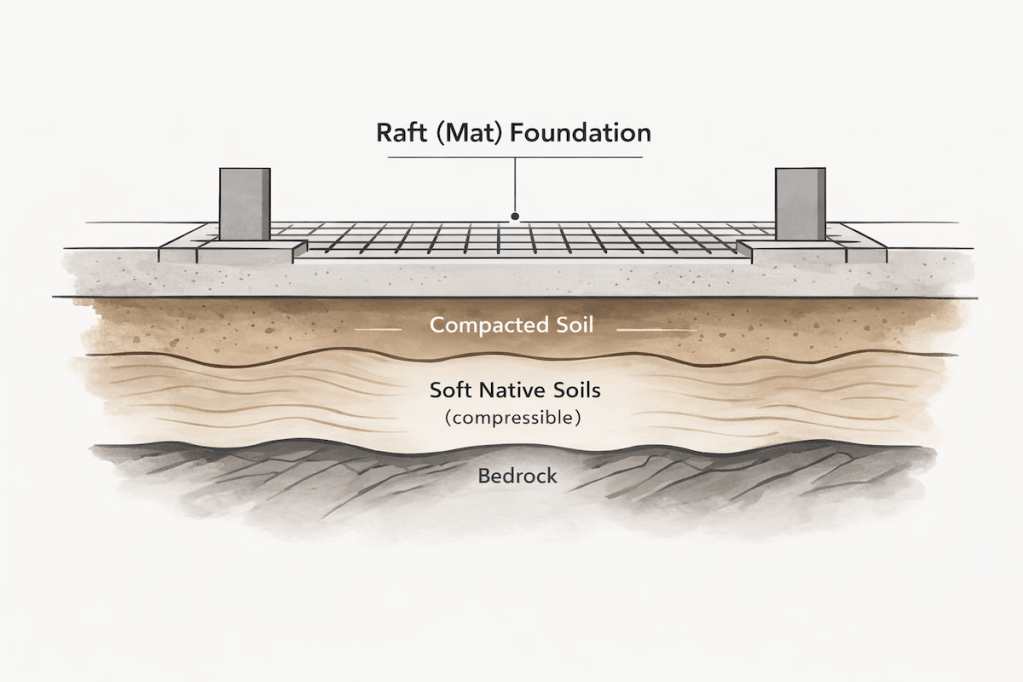
A raft (mat) foundation spreads the weight of a building across a broad reinforced concrete slab, helping reduce uneven settlement in soft soils. (interpretive engineering illustration)
Because soils in this area are soft and compressible, one approach often considered is a raft (mat) foundation. With bedrock roughly 40 feet below grade, driving piles to rock would be structurally reliable but potentially expensive. A raft system instead spreads the building’s weight across a large reinforced concrete slab covering most of the footprint.
By distributing the load over a broad area, the raft reduces pressure on the soil and helps limit uneven settlement.
A true raft foundation is not simply a thick slab. It must be carefully engineered using geotechnical data, settlement analysis, and structural load modeling. Reinforcement patterns and slab thickness are designed so the foundation acts as a structural plate interacting with the soils below.
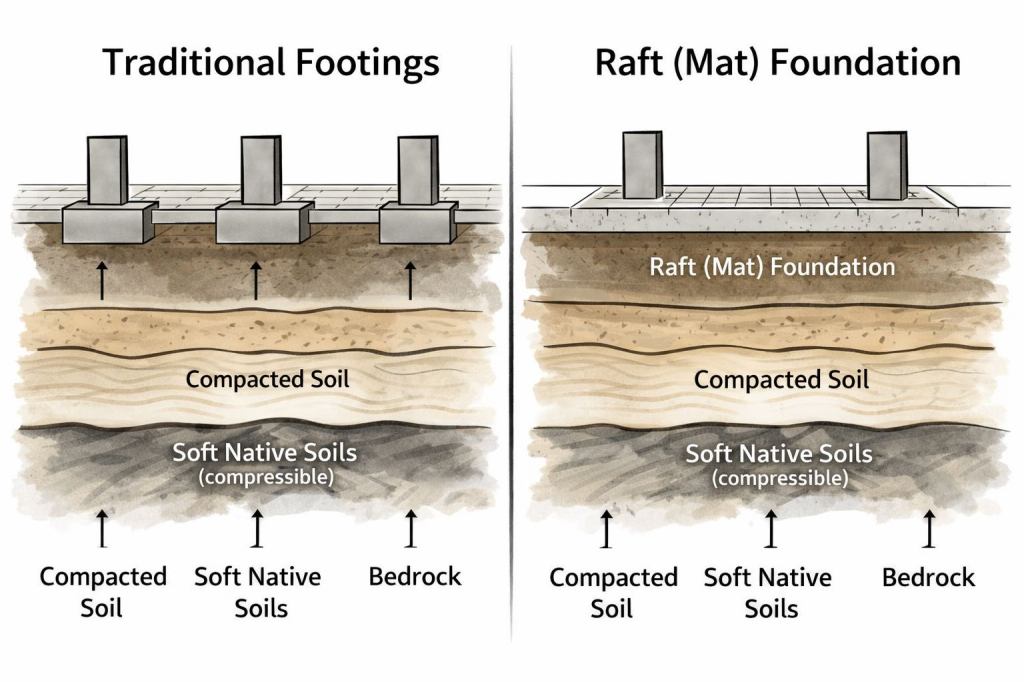
comparison of traditional footings and raft (mat) foundation systems – interpretive engineering illustration
What’s happening below the surface matters just as much as what’s built above. This diagram shows two very different ways of handling that relationship. With preloaded soils on this site, the question isn’t just what gets built – but how the ground will carry it over time.
 whatsgoingonhere.net
Please feel free to comment. First names are just fine.